The reality test
before race day.
You have done the training. Given the runner you actually are today, how should you race?
Race Intel starts with the runner you have actually built.
Most race calculators start with the finish time you want. Race Intel starts with the runner you have actually built.
Your actual training. Your long runs. Your previous races. The paces your body knows. Your experience. And the particular race you are preparing for.
Because race day does not magically create a different runner. The starting gun does not manufacture fitness.
This is not another pace calculator.
Tell a calculator you want to run a particular time and it can divide that time by 21.1 or 42.2 kilometres.
That is arithmetic.
Does the runner you have built support the race you want to run?
We study what you share with us, about yourself and about your running, alongside what we know about the race itself, and recommend the race strategy we believe gives you the best chance of doing justice to your training.
Honesty is part of Race Intel.
Built on experience. Backed by data.
Race Intelligence brings together Dr Rajat Chauhan's decades of experience in sports and exercise medicine, running, endurance performance and race organisation with published research, large-scale race data and runner-specific information.
The evidence we study includes research involving hundreds of thousands to millions of Half Marathon and Marathon performances, alongside large Indian race-result datasets covering more than three million performances.
And population averages are only the beginning. Your race is about you.
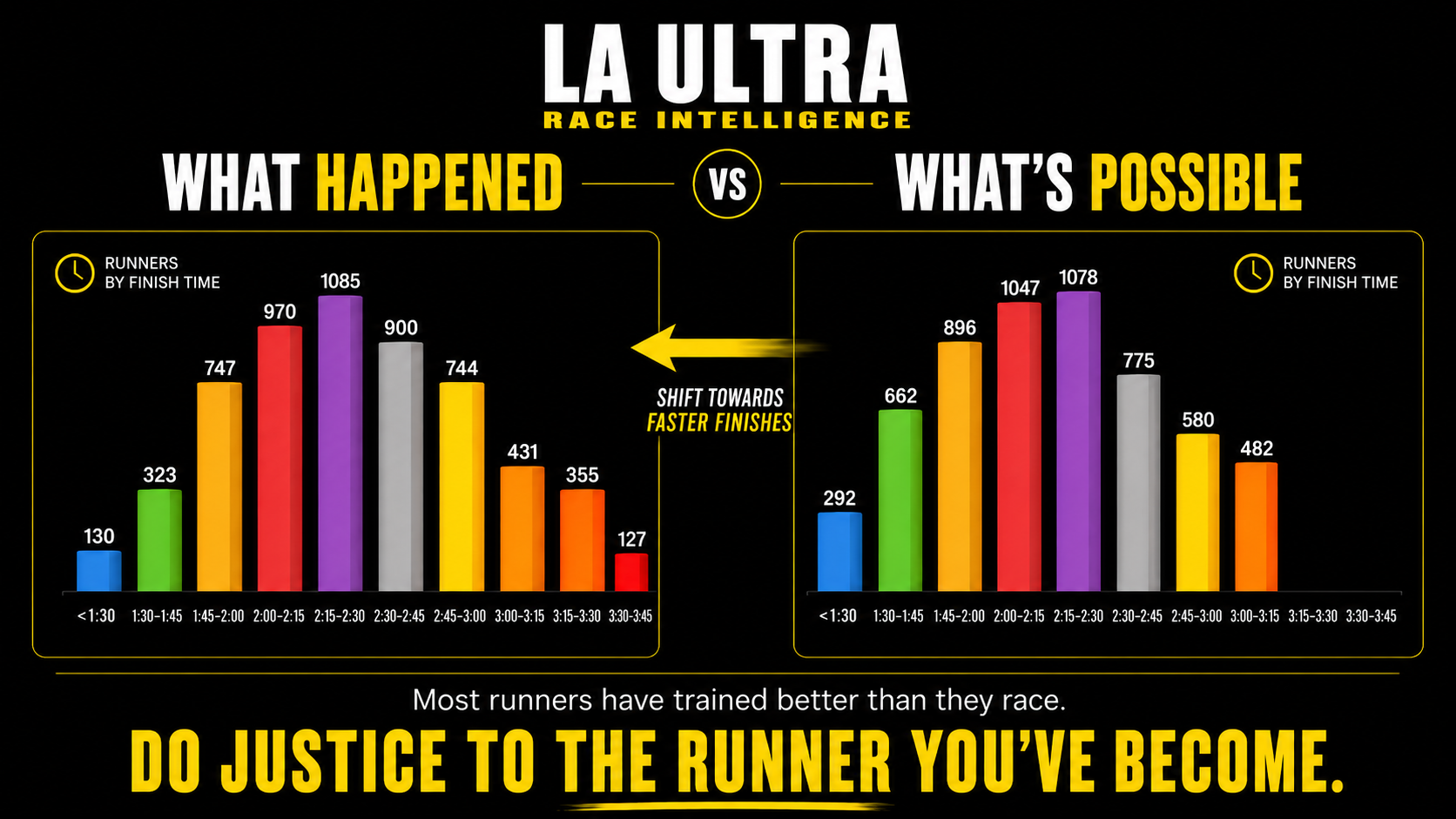
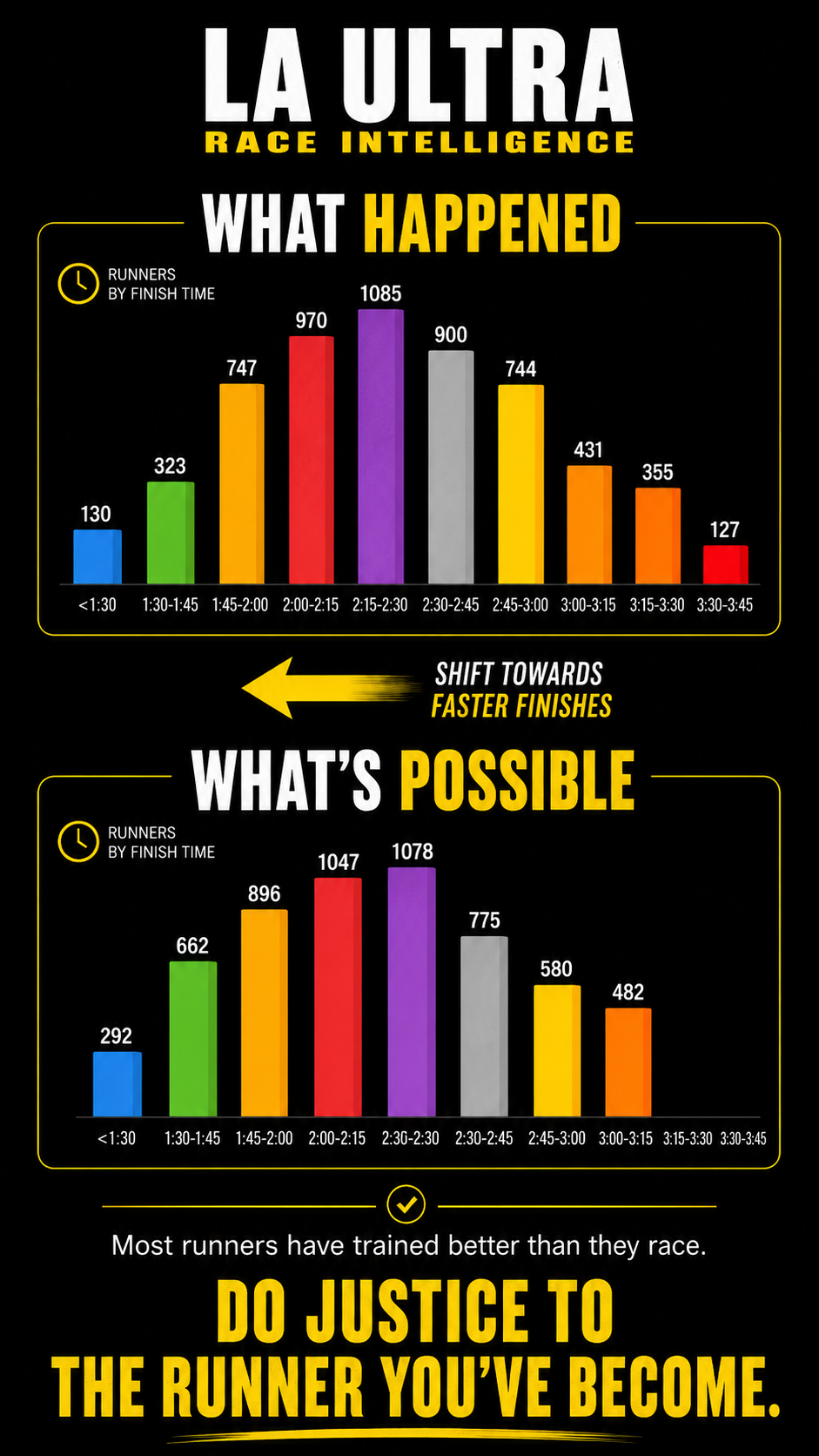
Most runners have trained better than they race.
The same field, twice. On the left, the finish times that actually happened. On the right, what the same runners' training suggested was available to them.
The runner. The race. The day.
Wherever sufficient information is available, Race Intel also considers the demands of the particular event you are running, including the course and expected conditions.
And two runners with the same PB are not necessarily the same runner.
We also consider the human being arriving at the start line, not only the numbers on their watch.
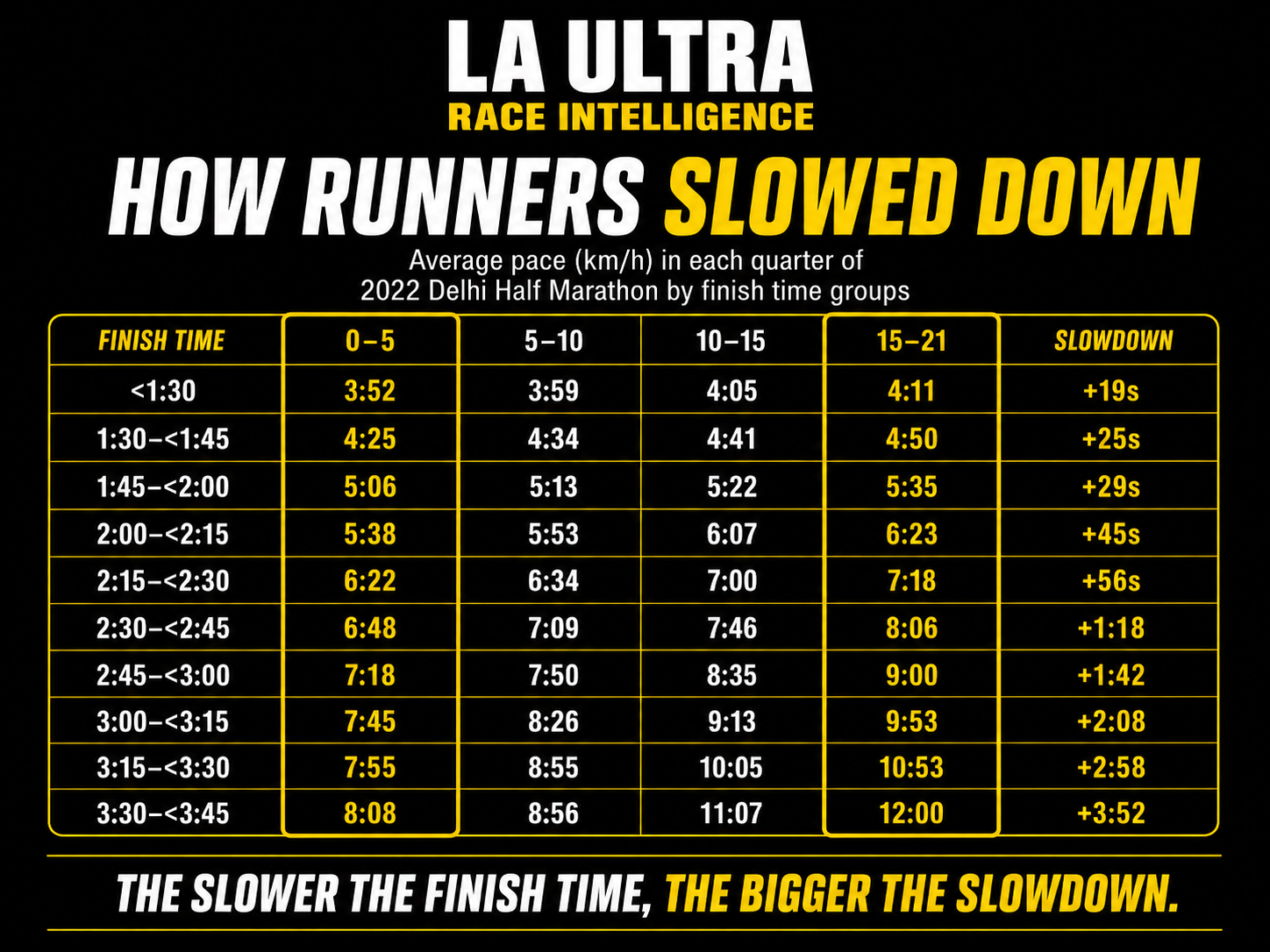
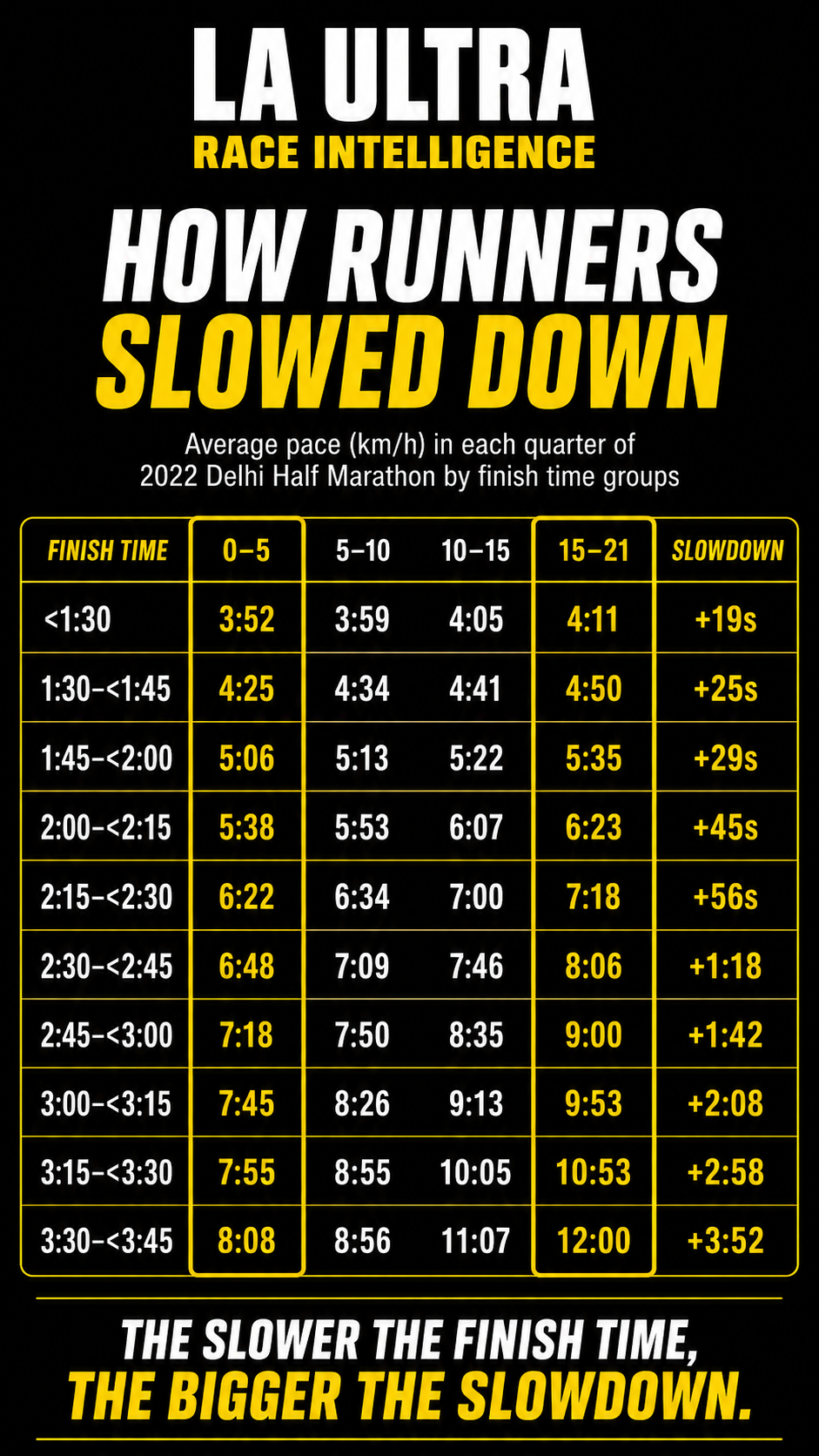
The slower the finish time, the bigger the slowdown.
Every group in that field ran the last quarter slower than the first. The gap widens from nineteen seconds a kilometre to almost four minutes.
Which is why the pace you start at is a decision, not a detail.
What do you receive?
We analyse the information you share with us and create a personalised Race Intel strategy for your upcoming Half Marathon or Marathon.
Your recommendation can cover the aspects most relevant to your race, including:
Help you get more out of the runner you have already built.
Not sell you a fantasy.
It takes approximately 20 minutes.
Tell us what you actually did, rather than what your training plan said you were supposed to do.
You upload screenshots of your longest recent run and your best recent race effort straight from your watch or running app, rather than typing splits out by hand.
There are no marks for good behaviour.
Better information helps us give you better Race Intelligence.
Not taking new races.
Race Intelligence is paused just now. Tell us which race is next for you and we will let you know when it reopens.
Tell us your next race →How much of the runner you have already built can you bring to the start line, and how much of that runner can you carry to the finish?
Smile before Socks and Shoes.
Keep miling and smiling.
Registration closed